Springboard
“We tend to have a lot of technical discussion and debate. That point will continue to be debated.”
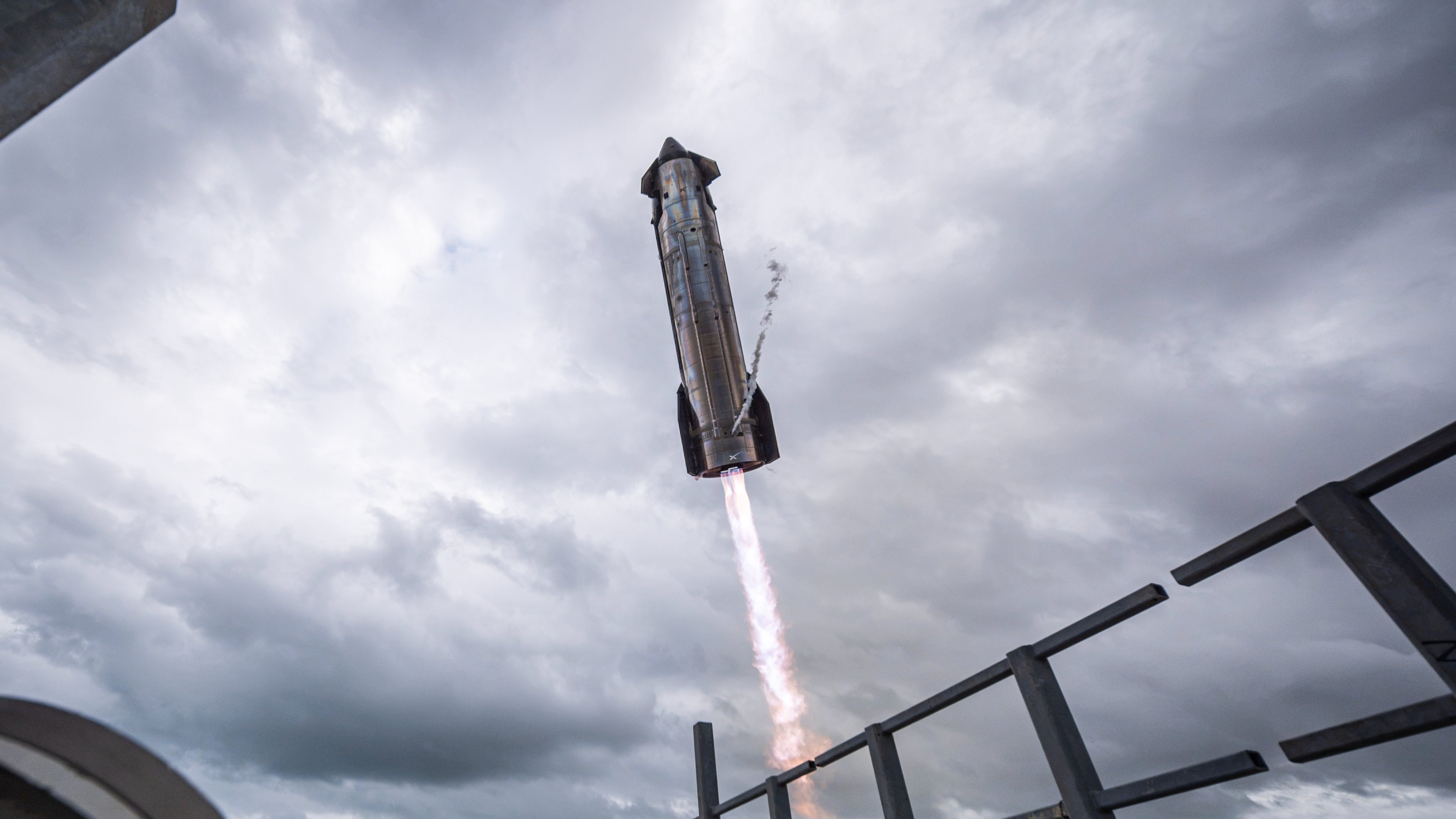
SpaceX's Starship returns to Starbase, Texas, on November 14, 2026, one day after launching from the same location atop a Super Heavy booster. Credit: SpaceX
SpaceX's Starship returns to Starbase, Texas, on November 14, 2026, one day after launching from the same location atop a Super Heavy booster. Credit: SpaceX
SpaceX’s successful recovery of its Starship rocket last weekend cleared a major hurdle on NASA’s path to the Moon, opening up possibilities for higher launch rates and an all-important, long-delayed orbital refueling demo next year.
For SpaceX’s purposes, Saturday’s mid-air rocket catch will help engineers learn how to rapidly reuse Starships. That should expedite SpaceX’s deployment of its newest generation of Starlink Internet satellites. NASA, meanwhile, believes a higher launch cadence will lead to faster learning as SpaceX develops a deep space version of Starship to ferry astronaut crews to the surface of the Moon.
Early next year, SpaceX plans to bring online a second Starship launch site at Kennedy Space Center, Florida. A second Starship factory is also under construction at Kennedy, joining SpaceX’s existing SpaceX production line at Starbase, Texas. With two launch sites, SpaceX will have the pieces in place to take the next leap with Starship.
The Starship refueling demonstration has slipped two years since late 2024, effectively a day-for-day delay as SpaceX ironed out technical problems with the vehicle. SpaceX may have turned a corner with Saturday’s first-ever catch of Starship at the launch tower.
There are other Starship lander tests coming next year. First will be NASA’s Artemis III mission, followed by an uncrewed Starship landing demonstration on the Moon. The former requires no orbital refueling, and the latter will need heaps of it.
Ars recently spoke with Steve Creech, the program manager for NASA’s Human Landing System. In this role, Creech oversees NASA’s contracts with SpaceX and Blue Origin to develop crew-rated lunar landers for Artemis.
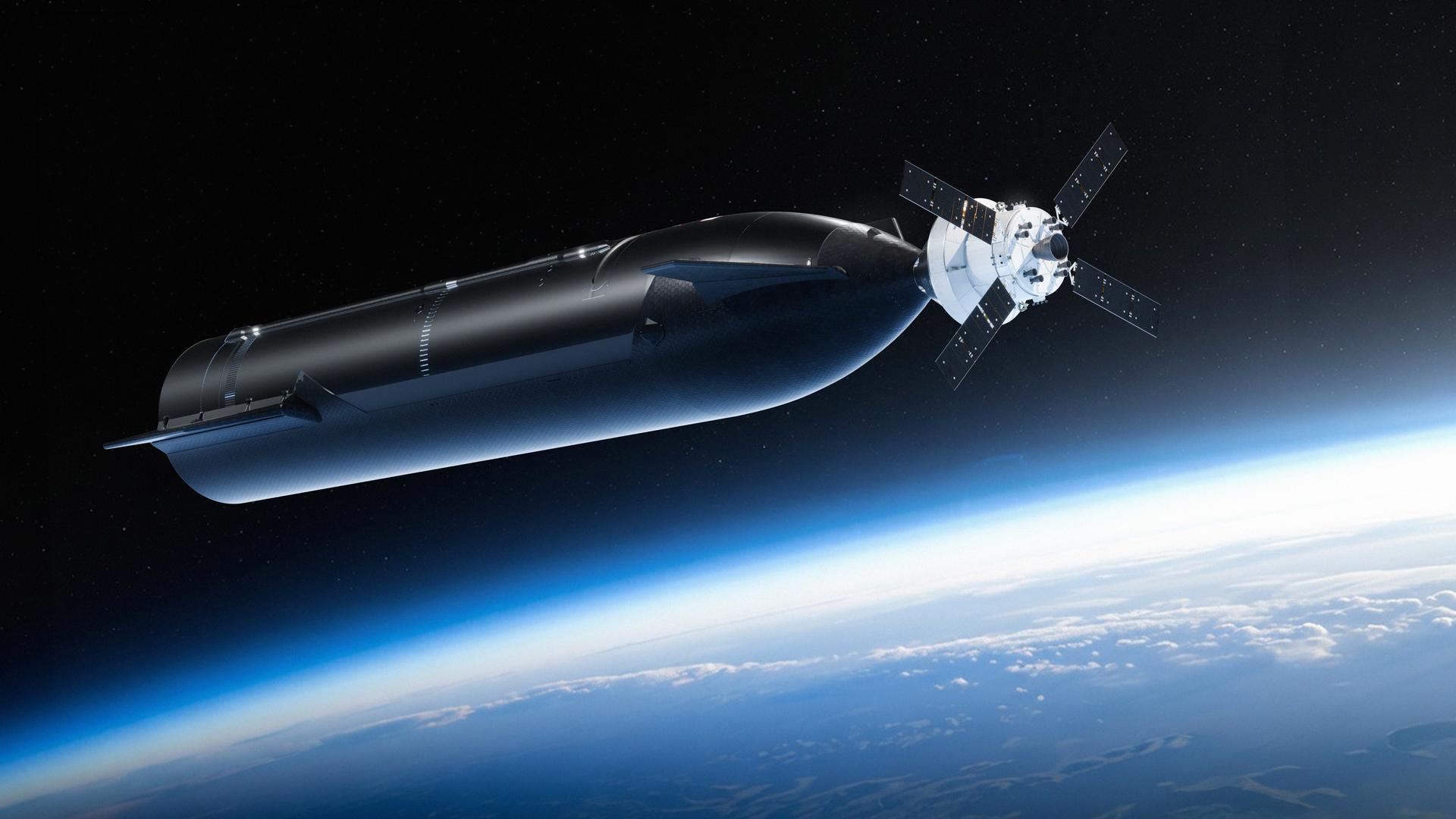
Artist’s illustration of Starship and Orion docked in low-Earth orbit.
Credit: NASA/SpaceX
Artist’s illustration of Starship and Orion docked in low-Earth orbit. Credit: NASA/SpaceX
Different landers, different priorities
For Artemis III, NASA will launch a four-man crew to low-Earth orbit on a Space Launch System rocket and an Orion spacecraft. Orion will first dock with Blue Origin’s Blue Moon lander for two days of tests, following its launch on a New Glenn rocket. The astronauts will open hatches and enter Blue Moon’s pressurized crew cabin to test the vehicle’s environmental control and life support systems.
Then, the astronauts will return to Orion and undock from Blue Moon to set up for a rendezvous and docking with SpaceX’s Starship in a slightly lower orbit, keeping it below most of SpaceX’s Starlink constellation. Orion will stay attached to Starship for just two hours, and the astronauts won’t enter the SpaceX vehicle.
NASA changed the plan for the Artemis III mission earlier this year, rerouting the flight plan from a lunar mission to a low-Earth orbit mission. This means the Artemis program’s first crewed lunar landing will be on Artemis IV, targeted to launch before the end of 2028.
So, why is Artemis III seemingly testing so much more with Blue Origin than with Starship? Creech told Ars a big reason is to maintain SpaceX’s focus on orbital refueling. Blue Origin no longer requires in-space refueling for Artemis landing missions. Also, SpaceX has extensive experience with life support systems with its Dragon crew spacecraft. Blue Origin has comparatively little.
“The bigger challenges for [SpaceX] were the prop transfer and getting to the uncrewed landing demo,” Creech said. “The thing that we’re going to learn more with Starship is, when we dock with Orion, they will have control of the attitude, control of the stack. That integrated stack control will be on the Starship side. So, with that huge of a vehicle, I think we’re going to learn more on that.
“With Blue, we’re going to have Orion control the stack for this mission,” Creech said. “When we get to a later mission, the Blue lander with fully loaded prop will have to control the stack. But with Blue, trying to mitigate risk, we’re going to have Orion do that.”
Artemis III will be Blue Origin’s first time flying a crew cabin for orbital spaceflight. Blue Origin has experience with suborbital space tourism, but those flights were brief and didn’t require the level of advanced life support necessary for longer durations. Blue Origin and NASA will emphasize those test objectives on Artemis III.
“I think SpaceX’s part was really, we need to focus on the docking,” Creech said. “If we added a crew cabin, that would slow us down on the other things and not add to what we’re already doing.”
The Starship on Artemis III will have a full complement of Raptor engines and a docking port on its nose. Blue Moon will not have any main engines when it links up with Orion on Artemis III, only a set of smaller thrusters for pointing control and minor maneuvers.
“With Blue, you don’t have a BE-7 engine, you don’t have the cryo tanks,” Creech said. “They’re representing the mass of the lander when it comes back from the surface because we think that’s the most critical case. But it does have the crew cabin.”
While there’s no Starship life support demonstration on Artemis III, NASA added a new milestone to SpaceX’s Moon lander contract to test parts of its crew cabin on the ground. The additional testing involves construction of a prototype crew compartment, called Cabin One, at SpaceX’s test site at Starbase, Texas.
NASA levied new test requirements on Blue Origin, too. The company plans to launch its first Blue Moon test mission early next year after a monthslong delay caused by a rocket explosion on Blue Origin’s launch pad in May. This version of Blue Moon, known as Mark 1, has a single hydrogen-fueled BE-7 main engine. Future human-rated landers from Blue Origin will have three.
“One of the things we added into the program in the last year is, we really felt like we needed a test of the three-engine configuration,” Creech said. The hotfire test of the three-engine Blue Moon propulsion unit will occur inside a vacuum chamber at NASA’s In-Space Propulsion Facility in Ohio.
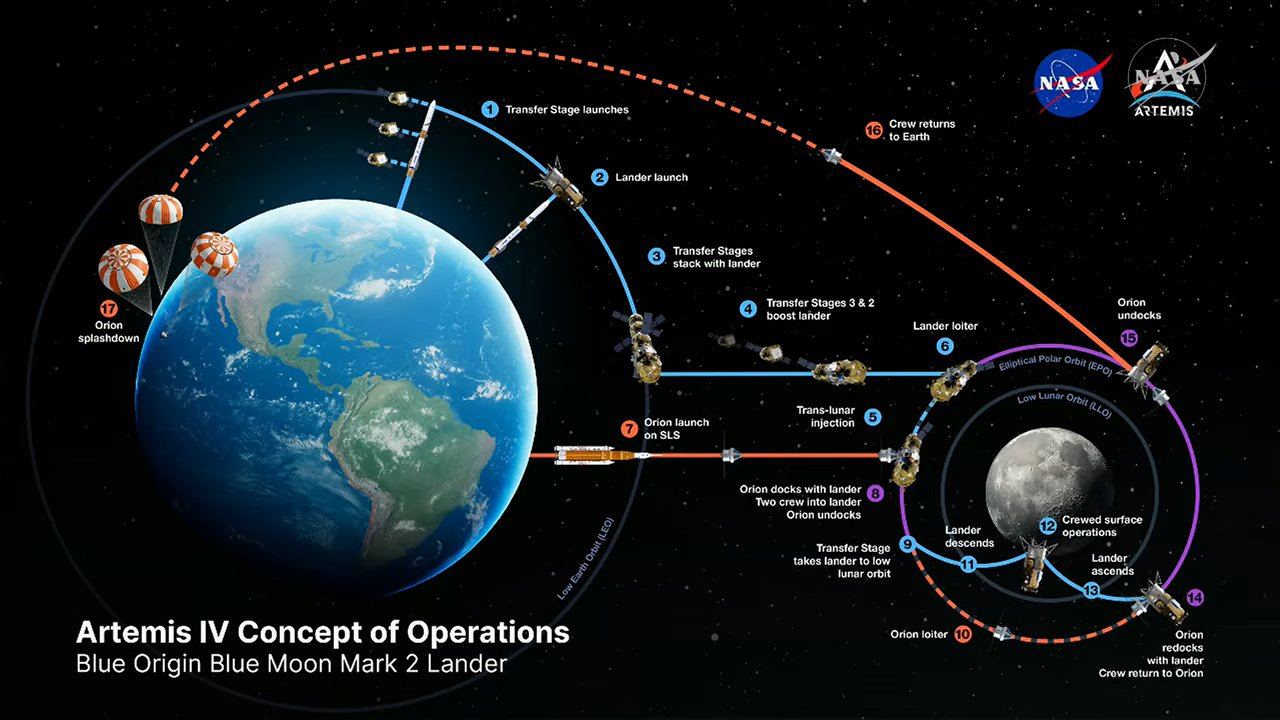
Blue Moon lunar lander concept of operations.
Credit: NASA
Blue Moon lunar lander concept of operations. Credit: NASA
Ease up, NASA
This year’s Artemis shakeup did more than change the flight plan for Artemis III. Engineers also altered the architecture for subsequent lunar landing missions. The updated plans will make life easier for teams working on Starship and Blue Moon. That’s not necessarily the case for Orion.
“Our previous architecture for both these landers required a 90-day loiter in lunar orbit for Orion to arrive,” Creech said. “That was something that, for both of these landers, drove a lot of complexity, and a lot of it made the lander job really hard.”
The new concept of operations does away with some of that complexity, according to NASA.
“One of the things we changed was that 90-day loiter,” Creech said. “SpaceX, they solved it by saying let’s do an Earth orbit rendezvous with Orion, and take Orion to the Moon. For both Blue Origin and SpaceX, we have updated their requirements to a four-day surface day initially. Before, our initial missions were six-and-a-half days.”
The six-and-a-half day surface stay was baked into the Artemis architecture because the Orion spacecraft was originally planned to settle into a long, looping path around the Moon, called a near rectilinear halo orbit. This orbit was predicated by the expected location of NASA’s now-canceled Gateway lunar space station. That, in turn, was driven by Orion’s inability to reach an orbit closer to the Moon.
Now, instead of rendezvousing with Starship near the Moon on landing missions, Orion will link up with Starship in high-Earth orbit. From there, Starship will propel it toward the Moon.
What’s still not clear, however, is whether SpaceX will have to refuel Starship at an altitude somewhere above low-Earth orbit. A graphic presented by Jeremy Parsons, NASA’s Artemis program manager, last month illustrated this possibility with a “final tanking orbit” before Starship docks with Orion in high-Earth orbit.
“We’re still working that out,” Creech said. “We’re making progress, but where we actually rendezvous with Orion is still in trade, so that’s why you saw a little bit of fuzziness there.”
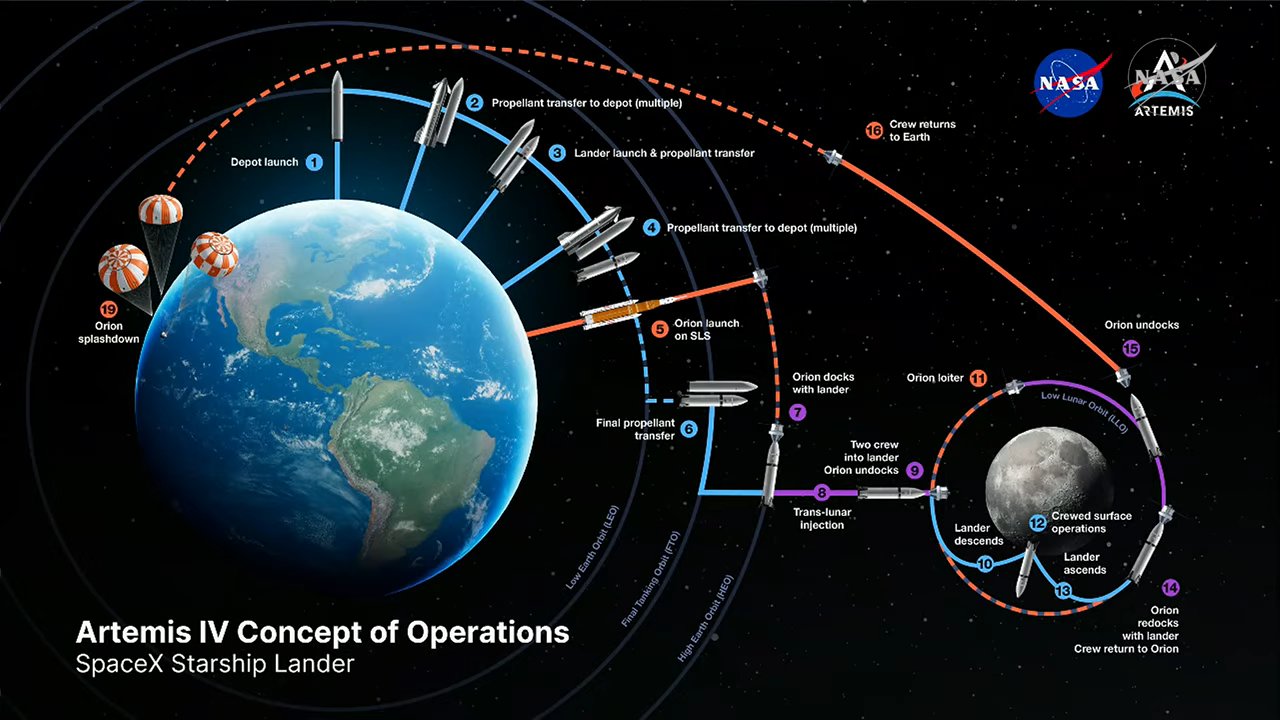
Starship lunar lander concept of operations.
Credit: NASA
Starship lunar lander concept of operations. Credit: NASA
For missions using Blue Moon, the lander will connect with Orion in orbit around the Moon. Blue Origin’s updated plans do away with the requirement for in-space refueling but will still require four launches of the company’s New Glenn rocket, one for the Blue Moon lander itself and three with transfer stages to boost it out of Earth orbit to the Moon.
A new stretched Centaur upper stage for the Space Launch System should give the rocket energy to send Orion to low-lunar orbit, which it could not reach with the current version of SLS. NASA has not determined if the new Centaur exploration stage will be ready in time for Artemis IV. If not, Artemis IV could fly with the last of NASA’s in-stock SLS upper stages.
NASA is also waiting to decide which lander to use on Artemis IV. In either case, two of Orion’s four astronauts will transfer into the landers for final descent to the lunar surface for a four-day stay, followed by takeoff and return to Orion.
Testing (nearly) everything
Starship and Blue Moon must each complete an uncrewed landing demonstration before a crew lunar mission. The landing demos are targeted for late 2027 or early 2028, Creech said, but they won’t necessarily test everything crews will need when they head for the lunar south pole.
Starship’s elevator, for example, is not part of SpaceX’s uncrewed landing demonstration. Engineers will use a test lab at Marshall Space Flight Center in Alabama to check the elevator’s performance in a simulated lunar environment.
NASA did not initially require SpaceX or Blue Origin to prove their landers could take off from the Moon before a crew mission. Government officials later added the lunar takeoff requirement for each company’s uncrewed landing demos.
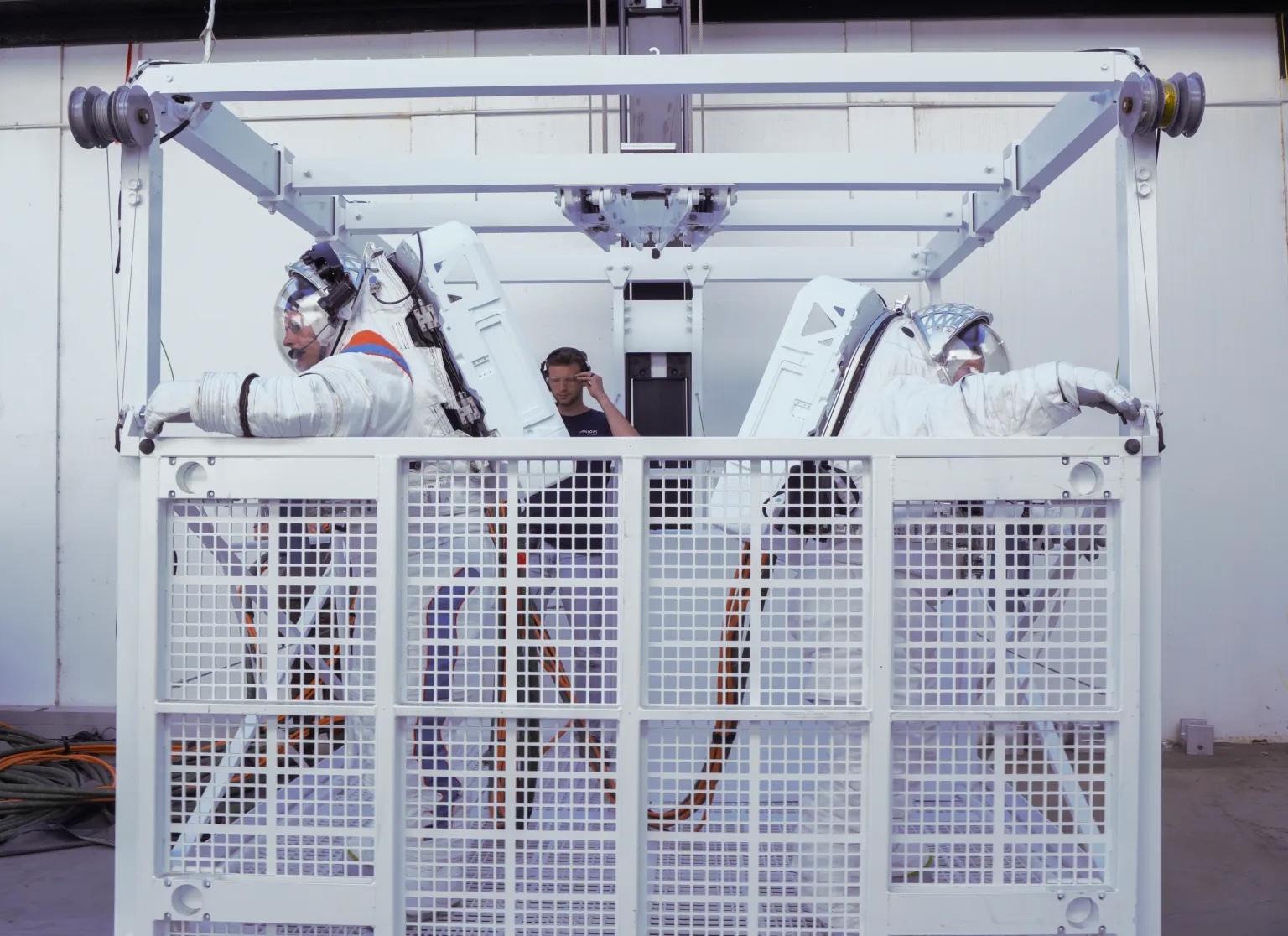
NASA astronaut Doug Wheelock and commercial Axiom Space astronaut Peggy Whitson test the compatibility of a prototype of Axiom’s lunar spacesuit with a prototype Starship elevator. The elevator will lower astronauts from Starship’s crew cabin to the lunar surface some 15 stories below.
Credit: SpaceX
NASA astronaut Doug Wheelock and commercial Axiom Space astronaut Peggy Whitson test the compatibility of a prototype of Axiom’s lunar spacesuit with a prototype Starship elevator. The elevator will lower astronauts from Starship’s crew cabin to the lunar surface some 15 stories below. Credit: SpaceX
For now, NASA is leaving the details of the uncrewed takeoff demo up to SpaceX and Blue Origin. During Apollo, NASA’s lunar lander never landed on the Moon before Neil Armstrong and Buzz Aldrin descended to the Sea of Tranquility. NASA did, however, fly a dress rehearsal around the Moon on Apollo 10 that included a test of the lunar module’s landing abort capability.
“Where we are today is, Blue will land and then do a full ascent back to the rendezvous point with Orion,” Creech said. “With SpaceX. They will land, they will take off again, get to main stage on the engines, and then they will do another landing on the surface.”
That could change. Today’s plan gives SpaceX two shots at proving Starship can safely land on the Moon, but it comes with tradeoffs.
“When I came into the program, I was like, ‘Why are we not going all the way to the rendezvous point?’” said Creech, who took over as HLS program manager in 2025. “Some of my key people felt strongly we would get more out of the way we’re doing it now. There are others that have different opinions… We tend to have a lot of technical discussion and debate. That point will continue to be debated.”
Propellant transfer on tap
For Starship, orbital refueling remains the key to the Moon. SpaceX’s propellant transfer demonstration will involve two Starships, one launched from Florida and another from Texas, docking together in low-Earth orbit and transferring a “meaningful” amount of propellant from one ship to the other, Creech said.
“The first quarter of next year, we will see a long-awaited propellant transfer test from SpaceX, where they launch two Starships in pretty close proximity, actually dock, and transfer, we’re calling it a meaningful amount, of propellant,” Creech told Ars. “That is going to be a big learning point if they pull that off, because their architecture depends on propellant aggregation and multiple propellant flights.”
The propellant transfer test will mark the first time one spacecraft has offloaded a significant quantity of cryogenic propellants—in this case, methane and liquid oxygen—onto another vehicle in space. It is the culmination of decades of government and commercial research on cryogenic orbital refueling. The results will tell engineers how much of the propellant will be lost from boil-off during the transfer.
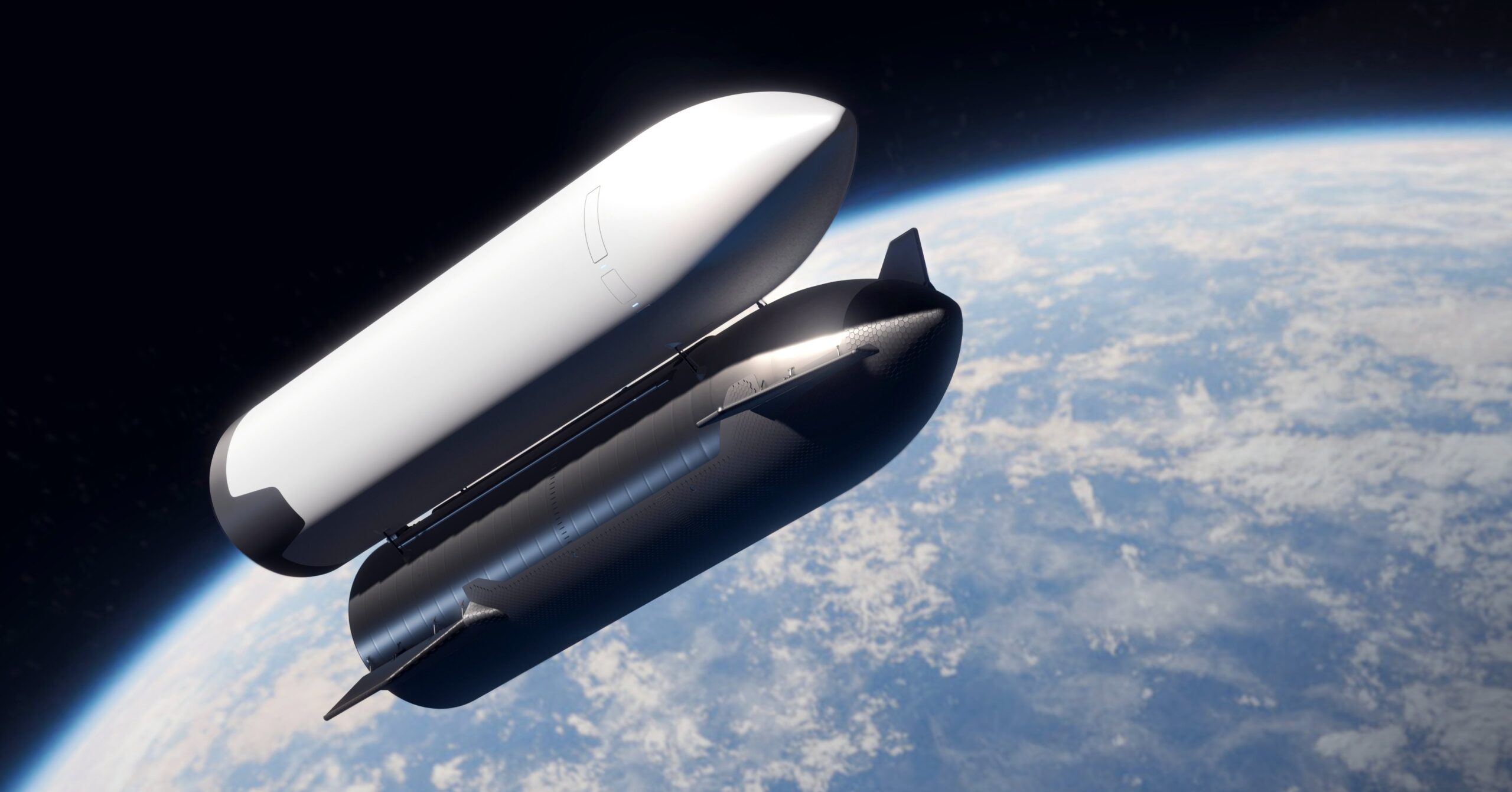
An artist’s illustration of two Starships docked together in low-Earth orbit.
An artist’s illustration of two Starships docked together in low-Earth orbit. Credit: SpaceX
That is one reason why there’s still so much ambiguity about how many Starship refueling tankers SpaceX will need to launch to give the Starship lunar lander enough gas to fly to the Moon. Without refueling, Starships are restricted to flights in low-Earth orbit.
The low end of the estimate for Starship tankers is six to eight refueling flights to support a Starship lunar mission. Those numbers come from Elon Musk, SpaceX’s founder and CEO, and fall below NASA’s own conservative planning figure of 20 refueling launches. Musk’s figures hinge on future Starship upgrades to reach the vehicle’s full potential. SpaceX’s goal is to get Starship’s lift capacity up to 100 to 200 metric tons of payload to low-Earth orbit. Today’s version of Starship, known as Starship V3, is still far short of 100 metric tons of payload capacity.
For context, a Starship carries 1,600 metric tons of propellant with its tanks full. Refueling flights using future fully-optimized Starships might be able to fill those tanks with as few as six tankers. That is not the case today.
SpaceX is working on a taller, heavier Starship called Starship V4. It will fly with nine Raptor engines, an upgrade over the six-engine variant flying today. In 2025, Musk said Starship V4’s first launch was targeted for 2027. There hasn’t been a recent update to the schedule for Starship V4.
The initial Artemis lunar missions will use Starship V3, Creech said.
Stephen Clark is a space reporter at Ars Technica, covering private space companies and the world’s space agencies. Stephen writes about the nexus of technology, science, policy, and business on and off the planet.
Source: Ars Technica · Stephen Clark
At a glance
- Topic
- Science
- Country
- 🇺🇸 US
- Publisher language
- EN
- Added to Allnira