No Starshield, no problem
Ukraine’s strike used homegrown tech while adapting battlefield lessons from its adversary.
Vantor satellite image shows multiple smoke generator vehicles obscuring part of the Crimea Bridge crossing over the Kerch Strait on June 22, 2026. Credit: Vantor
Vantor satellite image shows multiple smoke generator vehicles obscuring part of the Crimea Bridge crossing over the Kerch Strait on June 22, 2026. Credit: Vantor
A Ukrainian barrage of missiles and drones collapsed a crucial segment of Russian President Vladimir Putin’s prized Kerch Strait Bridge—and Ukraine’s military pulled off the strike deep within Russian-occupied territory without relying on the military-grade version of Elon Musk’s Starlink satellite communications to guide the missiles in.
On the nights of November 15 and November 16, coordinated waves of Ukrainian drones and missiles caused enough damage to collapse one of two steel arches supporting the Kerch bridge’s roadway for automobile traffic, according to an Institute for the Study of War update. Russian sources claimed several hundred Ukrainian drones first overwhelmed Russian air defenses to pave the way for remote-controlled missile strikes focused on the bridge, with the latter prominently including Ukraine’s homegrown Flamingo cruise missile.
The Ukrainian operation adapted a Russian battlefield innovation by using drones equipped with mesh radios to create an airborne communications network, according to the Financial Times. Each networked drone acts as a relay node to extend the communication link between human operators and remotely piloted missiles and strike drones. Russia began using the technique to support long-range drone and missile strikes on Ukrainian cities.
During the Ukrainian attacks on the Kerch Strait Bridge, the flying mesh network allowed operators located more than 250 kilometers away (155 miles) to remotely guide missiles and drones in evading Russian air defenses while also homing in on the bridge’s weakest structural points, according to the Financial Times.
Ukraine’s takedown of the bridge segment was preceded by weeks of preparatory strikes that systematically destroyed or degraded Russian air defense weapons, radars and electronic warfare equipment arrayed to protect the bridge. The November 15 night attack on the bridge also coincided with the largest Ukrainian overnight drone attack on Russia since the start of the full-scale war, Reuters reported.
Notably, Ukraine conducted the coordinated strike with primarily Ukrainian developed or adapted technologies. The Financial Times reported that “Ukrainian units involved in the operation deliberately avoided using Starshield, the military version of Musk’s Starlink satellite network,” because of recent US restrictions that prevent Ukraine from using Starshield on drones or anything else traveling more than 100 miles per hour (161 kilometers per hour).
Ukrainian President Volodymyr Zelenskyy said that the latest US-imposed restrictions on Starshield have not yet been lifted, although SpaceX denied that the restrictions had returned. Zelenskyy described the speed limit as interfering with some Ukrainian drone interceptor technologies that were designed to defend against Russian drones attacking Ukrainian cities and infrastructure.
However, the Ukrainian strikes on the Kerch Strait Bridge provide yet another example of how the Ukrainian military and defense technology companies have been learning to fight without relying on Starlink. This is also not the first time that Ukraine, arguably the leading country in developing new battlefield uses of drones, has adopted a Russian battlefield innovation for its own uses.
Ukraine video of missile strike on bridge.
A bridge too far
From Russia’s view, the only glimmer of good news may be that the bridge’s railway section was only moderately damaged. The Ukrainian newspaper Kyiv Independent pointed to Russian news and video sources indicating that trains appeared to be running again on the bridge after the strikes.
But the severe damage to the bridge’s arch and roadway section cuts off a crucial transportation and supply link between Russia and the Russian-occupied Crimean peninsula of Ukraine. The Institute for the Study of War assesses that the “destruction of the bridge” will complicate Russia’s ability to maintain its occupation and military basing within the peninsula.
The other overland supply route between Russia and Crimea involves highways running through Russian-occupied southern Ukraine. But Ukrainian forces have already been striking such highway infrastructure and the Russian supply trucks running along the exposed route.
Fallen debris from the bridge’s collapsed arch may also prevent any large ship traffic from passing through the Kerch Strait that connects the Sea of Azov and the Black Sea, according to a Telegram channel owner based in Crimea. That makes it even more difficult for Russia to resupply the Crimean peninsula by sea—and Ukrainian drones have previously struck dozens of Russian ships in the Sea of Azov.
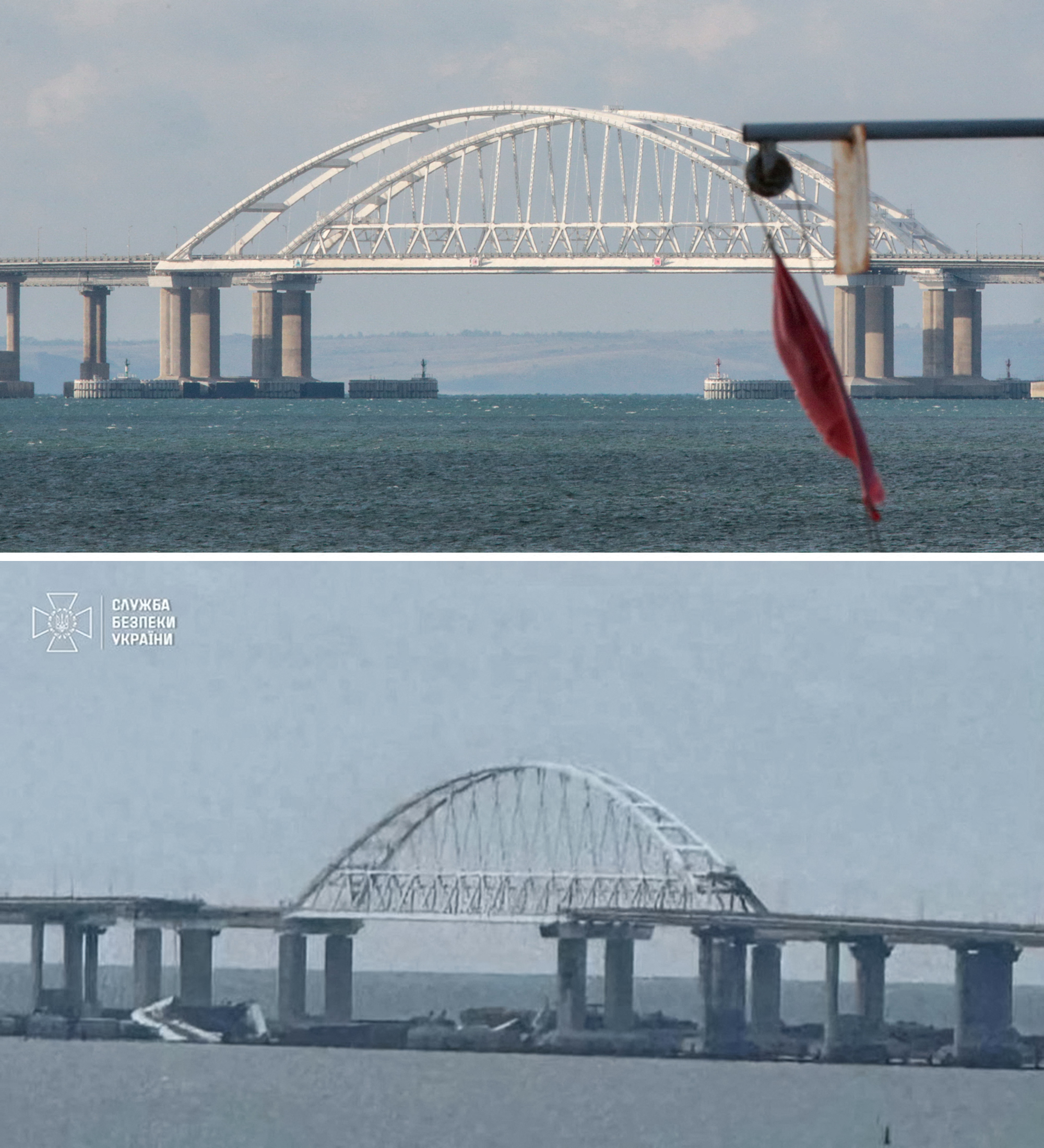
Still images from a Ukrainian Security Service video showing the damage after a strike on the Kerch Strait Bridge (bottom) compared with the intact bridge (top).
Still images from a Ukrainian Security Service video showing the damage after a strike on the Kerch Strait Bridge (bottom) compared with the intact bridge (top). Credit: AFP PHOTO / Ukrainian Security Service
Beyond the physical damage to the bridge, such attacks represent a symbolic blow to Putin’s ambition of holding onto the Crimean peninsula. After Russian forces seized Crimea from Ukraine in 2014, Russia based much of its Black Sea Fleet at the naval base in Sevastopol and later used the peninsula as a logistics hub for its full-scale invasion of Ukraine in February 2022.
The $3.5 billion Kerch Strait Bridge was built as a physical link to cement Russia’s claim over Crimea. Putin personally drove a construction truck across the bridge to commemorate its opening in 2018. He repeated the bridge-crossing feat in a Mercedes in December 2022, after a Ukrainian truck bomb attack temporarily damaged the bridge in October of that year.
In 2025, the bridge was damaged again after Ukraine’s Security Service used agents to plant mines under the bridge supports. Again, Russia repaired the damage.
The Kerch Strait Bridge’s future prospects look much bleaker now following the latest missile and drone strikes. The bridge was initially constructed in two years, and engineering experts told The New York Times that repairs to the bridge roadway could also take two years under normal circumstances. But they also agreed that any damage to the bridge’s piers could extend that repair time—and Russian repair efforts would likely be at risk from future Ukrainian missile and drone attacks.
Jeremy Hsu is a reporter exploring a wide range of topics across deep tech and AI. He has previously written for New Scientist, Scientific American, IEEE Spectrum, Wired, Undark Magazine and MIT Tech Review, among many other publications, about topics such as deepfakes, data centers, drones, battery tech, robotics, and GPS jamming. He also has a Master of Arts in Journalism from NYU, and a bachelor's degree from University of Pennsylvania in History and Sociology of Science, with a minor in English.
Source: Ars Technica · Jeremy Hsu
At a glance
- Topic
- Technology
- Country
- 🇺🇸 US
- Publisher language
- EN
- Added to Allnira