I will remain calm
A big study with very little beyond negative results still gets published.
It’s widely acknowledged that it’s nearly impossible to publish negative results in scientific journals. “We didn’t see anything” is a much harder sell than finding that a hypothesis is clearly right. Findings of no effect tend to either be shuffled off to low-profile journals or left behind as unpublished lab lore.
The high-profile journal Nature, however, made a notable exception this week, publishing a study that tells us that a bunch of methods we have been using to try to measure a key emotional ability don’t seem to be measuring the same thing. The results mean that we don’t have a good way to measure the impact of a concept that is the basis of a key method in therapy.
Inconsistencies
One of the most successful forms of therapy is cognitive behavioral therapy, or CBT. In part, CBT is based on getting people to step back and engage in “cognitive reappraisal.” This requires people to think over a situation that has caused a negative emotional response and find ways to reinterpret it so that it has less impact on them. The ability to engage in this process has been linked to emotional resilience.
Given its importance, a lot of studies have looked at what’s going on in the brain when people engage in cognitive reappraisal. There are also a number of questionnaires that are thought to measure a person’s capacity to engage in the process. So, a large international collaboration of researchers decided to look at these more carefully. “We focused on three widely used indices that are often assumed to reflect related facets of reappraisal capacity: trait questionnaires, task-based affective ratings following reappraisal, and amygdala down-regulation during reappraisal,” they wrote.
The amygdala is a structure deep in the brain that tends to be active when people have emotional responses to events (as well as in a wide variety of additional circumstances). So, it makes sense to expect that it would be less active if people were trying to tone down their emotions. But to find out whether that’s actually correct, you need to look at brain activity. Here, the team relied on 40 functional MRI data sets, providing a large enough data set to tease out even relatively small effects.
Which is a good thing, because the effects really were hard to detect. “The effect size was comparatively small: To detect this effect size with a statistical power of 80 percent, a single study would need to test 1,105 participants,” the researchers note, going on to say that very few fMRI studies have access to anywhere near that many subjects.
But there were even bigger problems when the differences among individuals in the MRI data were compared to their differences in the questionnaires or task-based ratings. Almost none of the variance in the different measures correlated with each other. We could go through the numbers, but a figure from the paper makes the issue quite clear.
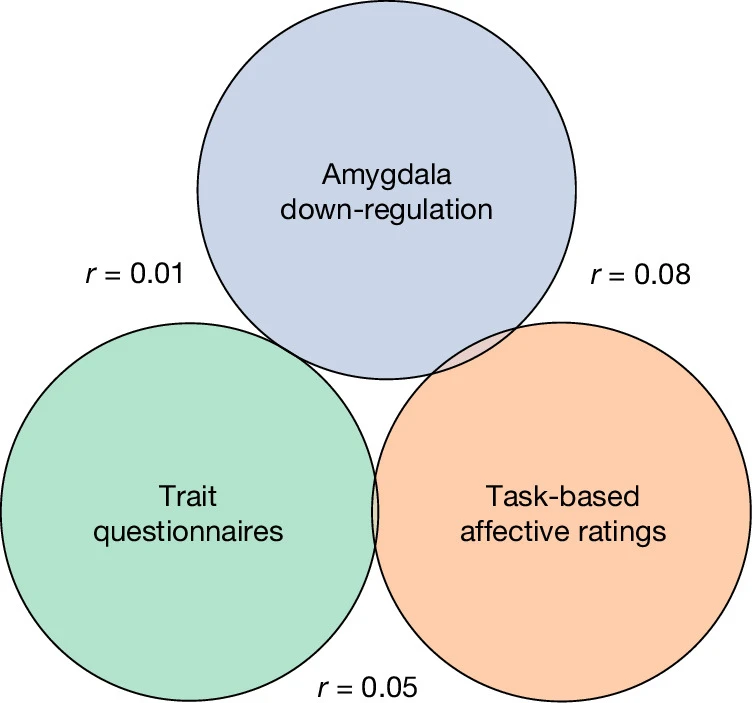
When one of the typical measures of emotional regulation varies, it rarely varies in a consistent way.
When one of the typical measures of emotional regulation varies, it rarely varies in a consistent way. Credit: Sicorello et. al.
An issue of timing?
Further issues became apparent when the researchers started looking at activity in the areas of the brain that are responsible for high-level decision-making. If people were really engaging their ability to re-evaluate emotional triggers, presumably these areas should be active, as they are needed to power the re-evaluation process.
But that wasn’t what the fMRI data showed. Instead, there was a correlation between the response of the amygdala and the response elsewhere in the brain. In other words, if the amygdala was very active, implying a stronger emotional response, then activity in the decision-making areas of the brain was also higher. If the emotional response seemed tamped down, then activity in the reasoning centers was lower as well.
In a bit of an understatement, the researchers declared, “These findings call for a fundamental reassessment of how reappraisal capacity is measured and interpreted across behavioural and neural levels of analysis.”
The primary issue is that these three ways of looking at emotional regulation were thought to be exploring the same thing, but it’s clear that they’re not. As the researchers point out, this probably shouldn’t be viewed as a surprise. The questionnaires typically ask about overall personality tendencies, and so cover a very long time period. The answers are also likely to implicate a variety of traits beyond simple emotional control.
Both the task-based ratings and fMRI work, by contrast, capture in-the-moment responses. But they do so under very, very different experimental circumstances—namely, one of them involves being stuffed in an MRI tube. Beyond that, many of the fMRI experiments involve simplifying the process of emotional regulation in order to get consistent data. It’s entirely possible that these differences also influence brain activity in a variety of ways.
So, the take-home appears to be that re-evaluation of emotional responses may be a real phenomenon, but we don’t currently have tools that can clearly capture the process effectively. Gaining that ability may require developing new methods, and thinking more clearly about what different stages of the re-evaluation process require. In the meantime, the people behind this work caution that “strong claims about a person’s emotion regulation capacity based on any specific brain region should be made with considerable caution.”
Nature, 2025. DOI: 10.1038/s41586-026-11203-1 (About DOIs).
John is Ars Technica's science editor. He has a Bachelor of Arts in Biochemistry from Columbia University, and a Ph.D. in Molecular and Cell Biology from the University of California, Berkeley. When physically separated from his keyboard, he tends to seek out a bicycle, or a scenic location for communing with his hiking boots.
Source: Ars Technica · John Timmer
At a glance
- Topic
- Science
- Country
- 🇺🇸 US
- Publisher language
- EN
- Added to Allnira